How to Choose the Right Size Air Purifier for Your Room

Choosing an air purifier can feel simple at first. You find the size of your room, check the coverage claim and choose a model that looks like it fits.
But in real homes, clean air performance depends on more than floor area alone.
The right air purifier size is influenced by room volume, ceiling height, airflow, filter quality, how enclosed the space is, how often the air in the room can pass through the purifier, and, importantly, the type of pollutants you want to remove.
Choosing a unit that is too small may still move air, but it may not clean the space effectively enough to make a noticeable difference. Likewise, choosing a purifier with the wrong type of filter may mean it is effective against particles such as dust and pollen but less effective against gases, odours or chemical pollutants.
This guide explains how to choose the right air purifier for bedrooms, living areas, home offices and open-plan spaces, while also considering the pollutants you want to remove.
Why Air Purifier Size Matters
An air purifier works by drawing air through a series of filters and returning cleaner air to the room.
If the purifier is correctly sized for the space, it can help reduce airborne pollutants such as:
- Dust
- Pollen
- Smoke particles
- Pet dander
- Mould spores
- Fine airborne particles
Depending on the filtration system fitted, some air purifiers can also help reduce certain:
- Household odours
- Volatile organic compounds (VOCs)
- Chemical vapours
- Smoke-related gases
- Other gaseous pollutants
If the purifier is too small, the air may not pass through the filtration system often enough to maintain a cleaner indoor environment.
This is especially important for people concerned about allergies, asthma triggers, dust, bushfire smoke, traffic pollution, household chemicals or indoor odours.
A larger room needs more airflow. A more polluted room may also need more frequent air filtration. And different pollutants require different types of filtration.
That is why both air purifier size and filter selection matter.
Don’t Rely on Floor Area Alone
Many air purifiers are described by the size of room they are suitable for. This is useful as a starting point, but it does not tell the full story.
A room’s floor area is only one part of the calculation. You also need to consider the volume of air in the space.
For example, a 20m² bedroom with a standard ceiling contains much less air than a 20m² room with a high raked ceiling. An open-plan living area may also connect to a hallway, kitchen or dining area, which means the purifier is effectively dealing with a much larger air space than the floor measurement suggests.
When choosing an air purifier, consider:
- The length and width of the room
- The ceiling height
- Whether the room can be closed off
- Whether the space connects to other rooms
- The main air quality concern
- Whether you are primarily concerned about particles, gases and chemicals, or both
- How sensitive the people in the room are to airborne pollutants
- Whether the purifier will be used during the day, overnight or continuously
A purifier that performs well in a closed bedroom may not be powerful enough for a large open-plan living area.
What Are Air Changes Per Hour?
Air changes per hour, often shortened to ACH, refers to how many times the air in a room can pass through the purifier in one hour.
For example, if a purifier can clean the equivalent volume of air in a room four times per hour, that would be four air changes per hour.
A higher number of air changes means the air is being filtered more frequently. This can be particularly helpful when dealing with fine particles, dust, smoke, allergens and other airborne pollutants.
To estimate the airflow you need, start with the room volume:
Length × width × ceiling height = room volume
Then multiply the room volume by your target number of air changes per hour.
For example:
4m × 3m × 2.7m = 32.4m³
If you want five air changes per hour:
32.4m³ × 5 = 162m³/hour
That means you would need an air purifier capable of delivering enough clean air to support that level of air movement in the room.
You do not need to calculate this perfectly, but it helps explain why a purifier that looks suitable by floor area alone may not always be the best choice.
Choosing an Air Purifier for a Bedroom
Bedrooms are one of the most common places to use an air purifier. They are usually smaller, easier to close off and used for long periods overnight.
A bedroom air purifier should be powerful enough to clean the room effectively, but quiet enough to run while you sleep.
For best results, close the bedroom door while the purifier is operating. This helps the unit focus on the air in that specific room rather than trying to clean air from surrounding spaces.
Bedroom air quality can be affected by:
- Dust and dust mites
- Pollen brought in from outside
- Pet dander
- Mould spores
- Smoke particles
- Household cleaning products
- Fragrances and other chemical vapours
- Fine particles and gases from nearby traffic or outdoor pollution
For most bedrooms, a compact air purifier with strong filtration and suitable airflow is usually the best fit.
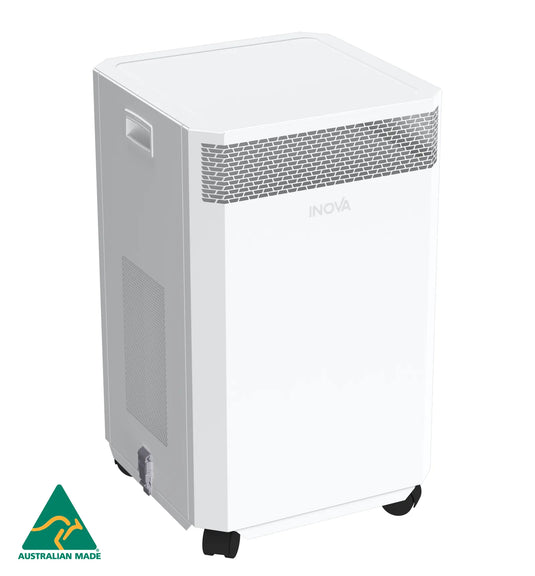
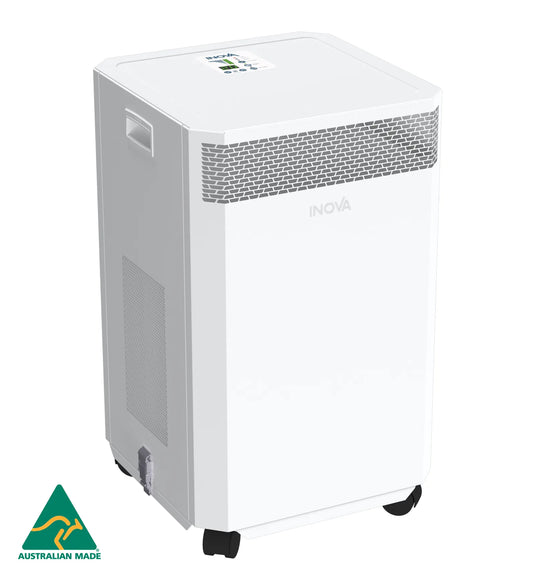
INOVA’s Core and Core Plus models are designed primarily for bedroom use, making them suitable options for smaller enclosed spaces.
If chemicals, gases or odours are a particular concern, also check the filtration configuration of the purifier to ensure it includes the appropriate gas-phase filtration media for the pollutants you are trying to reduce.
Choosing an Air Purifier for a Home Office
A home office may be smaller than a living area, but it can still benefit from cleaner air, especially if you spend several hours a day in the room.
If your office is a separate room, sizing is usually straightforward. Measure the room, consider the ceiling height and choose a purifier that can comfortably filter the air in that enclosed space.
If your office is part of an open-plan area, you may need to size the purifier for the larger connected space rather than just the area around your desk.
Indoor air quality in a home office may be affected by airborne dust, fine particles and odours, but it can also be affected by gases or VOCs released by cleaning products, paints, adhesives, furnishings, printing equipment and other indoor sources.
If these are a concern, choosing a purifier with both effective particle filtration and appropriate chemical or gas filtration can provide a more complete approach to indoor air cleaning.
Choosing an Air Purifier for a Living Room
Living rooms are often larger than bedrooms and may have more air movement from people, pets, open doors and connected spaces.
This is where many small air purifiers struggle. A unit designed for a bedroom may not have enough airflow to clean a large living area effectively.
When choosing an air purifier for a living room, consider:
- The total size of the room
- Whether it connects to the kitchen or dining area
- Whether there are high ceilings
- Whether pets spend time in the space
- Whether smoke, cooking odours or outdoor pollution are concerns
- Whether household chemicals or VOCs are a concern
- How often the purifier will be running
For larger living spaces, a higher-capacity air purifier is usually the better choice.
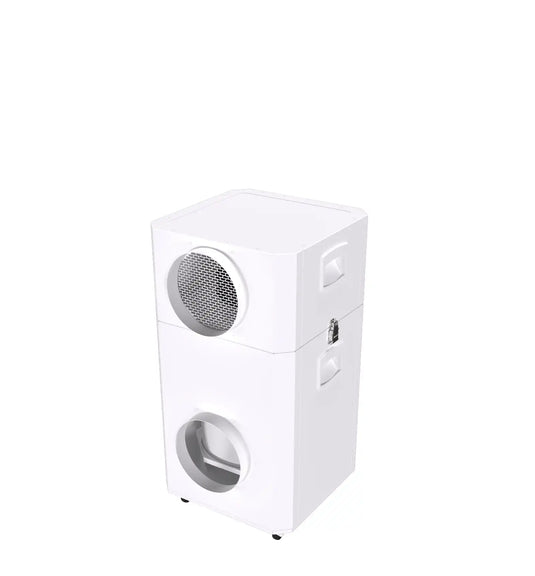
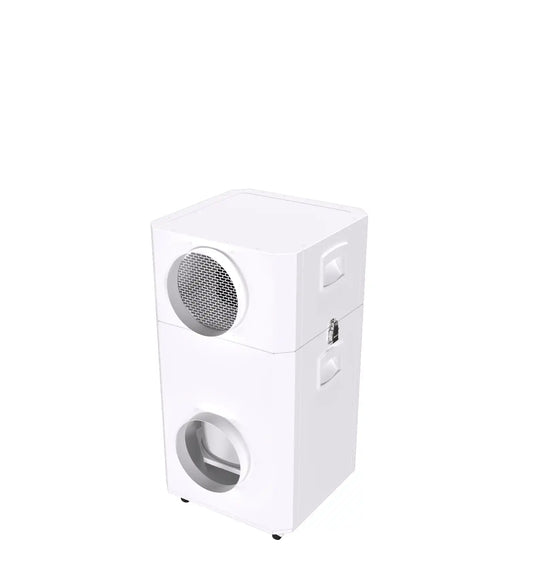
INOVA’s E20 and DE20 models are designed for larger living areas and can also be moved to bedrooms for nighttime use when needed.
Choosing an Air Purifier for Open-Plan Spaces
Open-plan homes can be harder to size because the purifier may be dealing with a much larger volume of air.
A lounge room that connects directly to a kitchen, dining area and hallway is not just one room from an air-cleaning perspective. Unless doors or partitions can close the area off, the purifier is working across the full connected space.
Open-plan spaces can also contain a broader range of pollutants. Along with dust and allergens, cooking, cleaning products, furnishings and outdoor air can introduce particles, odours and gaseous pollutants.
In open-plan areas, look for a purifier with higher airflow and strong filtration capacity.
You may also need to think about placement. Positioning the purifier where air can circulate freely will generally be more effective than placing it in a tight corner or behind furniture.
For large open spaces, one higher-capacity unit may be suitable, or in some homes, multiple units may be more effective than expecting one small purifier to manage the entire area.
Particles, Chemicals and Gases Require Different Filters
This is one of the most important things to understand when choosing an air purifier.
Not every air pollutant behaves in the same way, and no single type of filter is designed to remove everything.
HEPA Filtration for Airborne Particles
Medical-grade HEPA filtration is designed to capture very fine airborne particles.
This can include pollutants such as:
- Dust
- Pollen
- Pet dander
- Mould spores
- Fine particulate pollution
- Smoke particles
For homes where these particles are the main concern, the quality of the HEPA filter and the amount of air passing through it are critical.
However, HEPA filters are particle filters. They are not designed to remove gases or chemical vapours from the air.
Activated Carbon for Gases, Chemicals and Odours
Gases and chemical pollutants require a different approach.
An air purifier equipped with suitable activated carbon or other gas-phase filtration media can help reduce certain gases, odours and chemical pollutants from the air.
These can include pollutants associated with:
- Household cleaning products
- Paints and solvents
- New furniture and building materials
- Cooking
- Smoke
- Traffic pollution
- Household odours
- Some volatile organic compounds
The key point is that the purifier needs to contain the appropriate filter media for the contaminant you want to remove.
If chemicals or gases are one of your main indoor air quality concerns, do not choose a purifier based solely on its HEPA rating or room coverage.
Check whether the filtration system includes appropriate gas-phase filtration and whether that filter is designed for the types of contaminants present in your environment.
What About Bushfire Smoke?
Bushfire smoke is a good example of why different filtration technologies matter.
Smoke can contain both fine airborne particles and gaseous pollutants.
A high-quality HEPA filter can help capture fine smoke particles, while suitable activated carbon or other gas-phase filtration media can help reduce certain smoke-related gases and odours.
If smoke is a major concern, choosing a purifier that combines strong particle filtration with appropriate gas filtration provides a more comprehensive approach than relying on HEPA filtration alone.
Filter Quality Is Just as Important as Airflow
Airflow matters, but it is not the only factor.
A purifier needs to move enough air, but it also needs to filter that air properly.
A high airflow rate means little if the filtration system is not capable of addressing the pollutants you are concerned about.
For homes affected by dust, smoke, allergens, mould spores or fine airborne particles, high-quality HEPA filtration is important.
For homes affected by odours, chemical vapours, VOCs or gaseous pollutants, the purifier also needs appropriate activated carbon or other gas-phase filtration.
This is why choosing an air purifier should not be based on room size alone.
The best option is one that combines:
Appropriate airflow + effective particle filtration + appropriate gas filtration where required.
Should You Choose a Bigger Air Purifier?
In many cases, choosing a slightly larger air purifier can be a smart decision.
A higher-capacity unit can often clean the air more quickly or operate at a lower fan speed while still delivering suitable performance. This may be useful in bedrooms, living areas or homes where the purifier is used for long periods.
However, bigger is not always necessary.
A compact, high-quality purifier may be the right choice for a small bedroom, while a larger system is better suited to open-plan spaces or high-use living areas.
And remember that a larger purifier does not automatically mean it can remove a wider range of pollutants. Its filter configuration still matters.
The goal is not simply to buy the biggest unit. The goal is to choose the right purifier for both the room and the air quality problem you want to address.
Quick Air Purifier Checklist
Before choosing an air purifier, ask:
- What room will the purifier be used in most often?
- What are the room dimensions?
- Is the ceiling standard height or higher than usual?
- Can the room be closed off?
- Is the space open-plan?
- What pollutants are you most concerned about?
- Are they particles, gases and chemicals, or a combination of both?
- Does the purifier have suitable HEPA filtration for fine particles?
- If gases, VOCs or odours are a concern, does it have appropriate activated carbon or gas-phase filtration?
- Will the purifier run overnight, during the day or continuously?
- Do you need a compact bedroom unit or a larger living-area unit?
- Is the purifier powerful enough to deliver multiple air changes per hour?
Answering these questions will help you choose a unit that suits your actual space and your specific air quality concerns, rather than simply relying on the room-size number printed on a product listing.
The Bottom Line
The right air purifier depends on more than square metres.
To choose the best air purifier for your home, think about room volume, ceiling height, airflow, air changes per hour, filter quality, whether the room is enclosed or open-plan, and the pollutants you want to remove.
For airborne particles such as dust, pollen, mould spores and smoke particles, high-quality HEPA filtration is important.
For gases, chemical vapours, VOCs and odours, the purifier must also contain appropriate gas-phase filtration, such as activated carbon. A HEPA filter alone is not designed to remove these gaseous pollutants.
For bedrooms and smaller enclosed rooms, a compact air purifier with strong filtration may be ideal. For larger living areas, open-plan homes or higher pollutant loads, a more powerful system is usually the better choice.
By matching both the purifier and its filters to your room and your air quality concerns, you give it the best chance of doing what it is designed to do: helping you breathe cleaner indoor air.
Explore the INOVA Air Purifiers range to find the right model and filtration configuration for your bedroom, living area or whole-home air quality needs.