The Great Escape: Why Most Air Purifiers Fail to Capture All Particle Sizes

When you buy an air purifier, the box usually boasts a "HEPA" filter and a 99.97% efficiency rating. It sounds perfect—like a microscopic security guard blocking every intruder. However, the reality of indoor air quality is far more complex.
Many "inferior" or budget air purifiers have a "blind spot" for certain particle sizes, allowing them to circulate back into your room. At INOVA, we believe understanding the science of air filtration is the first step toward breathing truly clean air.
The "U-Shaped" Problem of Filtration
Air filtration isn't a simple sieve where "big things get caught, and small things go through." Instead, high-quality filters rely on three distinct physical mechanisms to catch particles. Inferior purifiers often fail because they don't balance these mechanisms effectively.
1. Impaction (The Big Ones)
Large particles (like dust and pollen) have too much momentum to follow the air's path around filter fibres. They crash directly into the fibres and get stuck.
2. Diffusion (The Tiny Ones)
The smallest particles (like viruses and smoke) are so light that they get pushed around by air molecules in a zig-zag pattern called Brownian Motion. This erratic movement makes them much more likely to eventually bump into a fibre and stick.
3. The Middle Gap (The MPPS)
There is a specific size—roughly 0.3 microns—known as the Most Penetrating Particle Size (MPPS). These particles are too small to be caught by impaction but too large to be moved significantly by diffusion. They are the "Houdinis" of the air world.
Why Inferior Purifiers Fail: Budget purifiers often use "HEPA-type" filters made from thin, loosely packed synthetic fibres. While they might catch large dust, they don't have the fibre density required to trap the MPPS. These 0.3-micron particles simply "drift" through the gaps and back into your lungs.
The Hidden Flaw: Air Bypass
Even the best filter media is useless if the air doesn't actually go through it. This is the most common reason inferior air purifiers fail to capture particles of all sizes.
In many mass-market units, the filter is held in place by a simple plastic or cardboard frame. Because these materials are not perfectly rigid or airtight, air follows the path of least resistance. Instead of forcing its way through the dense filter fibres, a significant portion of the air—and the pollutants it carries—leaks through the gaps around the edges of the filter.
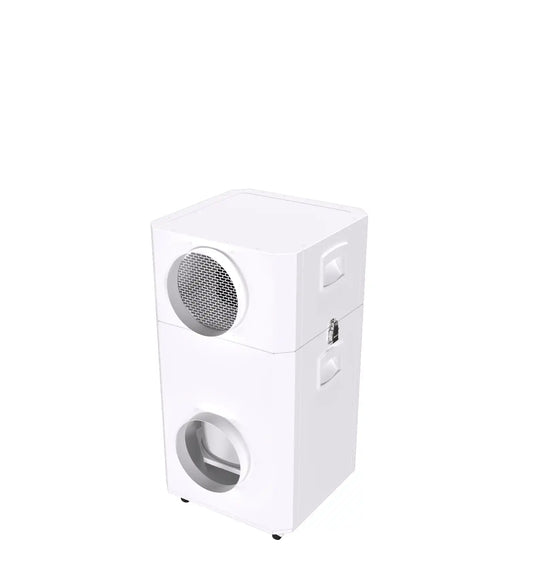
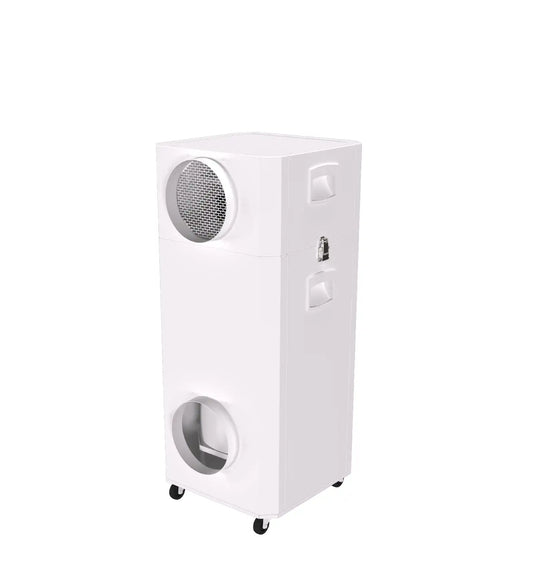
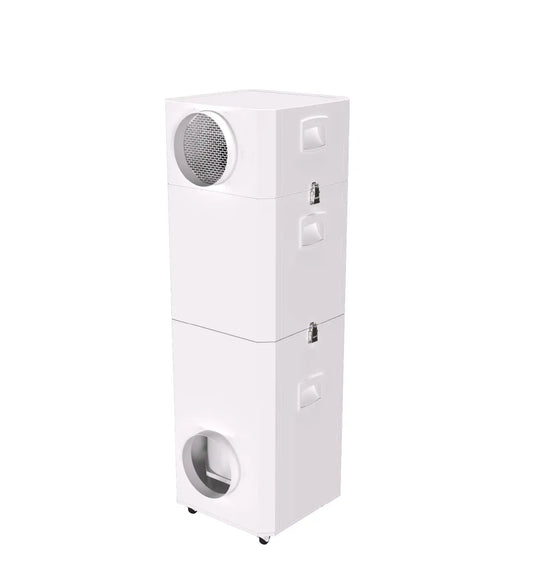
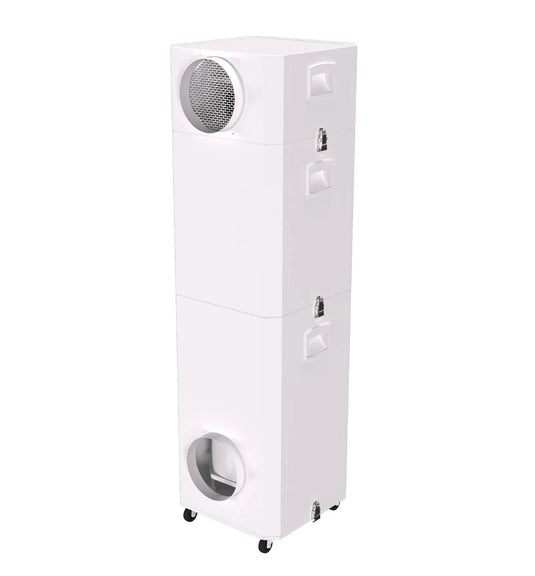
At INOVA, we solve this with:
- Steel Construction: Our filters are housed in airtight, powder-coated steel casings.
- High-Pressure Seals: We use medical-grade gaskets to ensure that 100% of the air is forced through the filter, not around it.
Material Matters: Synthetic vs. Glass Fibre
Many inferior purifiers use polypropylene (plastic) filters that rely on a temporary electrostatic charge to "pull" particles in. While effective on day one, this charge fades quickly—especially in humid conditions—causing the capture rate for fine particles to plummet.
INOVA uses medical-grade, non-shedding glass fibre paper. This provides a permanent mechanical barrier. It doesn't rely on "static cling"; it relies on a dense, multi-layered maze of fibres that captures particles down to 0.003 microns (100 times smaller than the standard HEPA requirement).
The INOVA Difference
| Feature | Standard "HEPA-Type" | INOVA Medical-Grade |
|---|---|---|
| Filter Media | Synthetic Polypropylene | High-density Glass Fibre |
| MPPS Capture | Often less than 90% | Certified 99.97% or higher |
| Airtight Seal | Plastic/Cardboard (High Leakage) | Steel/Gasket Seals (Zero Bypass) |
| Ultra-fine Particles | Mostly missed | Captured down to 0.003 microns |
Don't settle for "mostly clean" air. By eliminating bypass and utilising high-density mechanical filtration, INOVA ensures that even the most difficult-to-catch particles stay trapped for good.